← Back to Valve Parts for Oil & Gas
The Greater Houston energy corridor is the global hub for wellhead equipment, flow control manifolds, and high-pressure drilling systems. In severe-service production environments across the Permian Basin, Eagle Ford, and Gulf of Mexico deepwater assets, choke valves handle extreme differential pressures (ΔP), erosive proppant slurry, and aggressive fluid chemistry.
Carbidea provides made-to-print tungsten carbide choke valve components — including valve seats, needle stems, flow beans, cage sleeves, and wear rings — tailored to your exact drawings in prototype and short-run production batches.
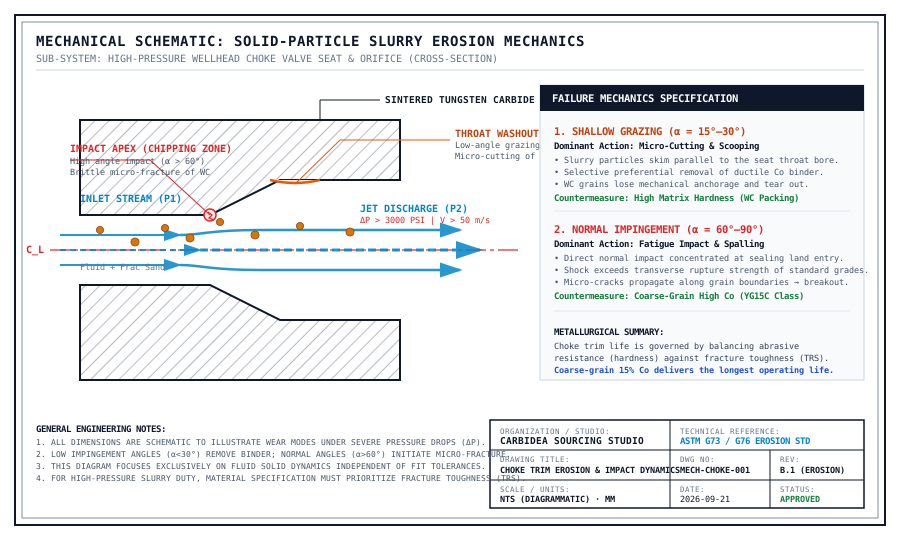
When high-pressure gas or crude passes through a restrictive choke orifice, fluid velocity escalates dramatically. Replaced choke seats in the field frequently exhibit two distinct failure modes:
To eliminate brittle failure, we recommend coarse-grain, high-toughness formulations such as the YG15C high-toughness grade class (15% cobalt binder, TRS ≥ 3200 N/mm²). As detailed in our choke valve trim specification guide, balancing fracture toughness against abrasive resistance extends trim operating life far longer than specifying hardness alone.
In sour gas production containing dissolved H&sub2;S, CO&sub2;, or heavy completion brines, conventional cobalt binders are vulnerable to chemical leaching. Once the cobalt binder is selectively dissolved by acidic media, the tungsten carbide skeleton loses cohesion, causing rapid surface crumbling and loss of shut-off integrity.
For these severe operating environments, we manufacture trim components utilizing corrosion-resistant nickel-binder carbide (YN series). Nickel-alloyed binders resist binder leaching in sour and acidic conditions, maintaining critical seal land geometry without sacrificing wear life.
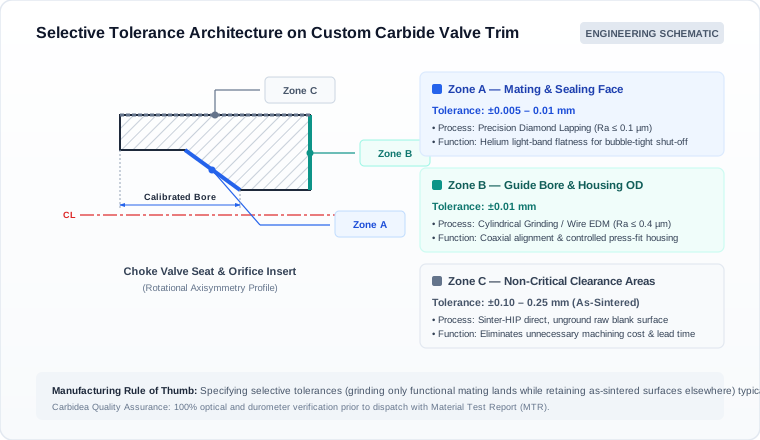
Accurate flow control and bubble-tight shut-off require precise manufacturing tolerances:
Whether you are validating a new choke trim design for an NPI project or producing replacement trim sets for emergency valve repairs, Carbidea is built for small-batch flexibility:
Related Engineering Resources: Choke Trim Spec Guide · Valve Seat Failure Analysis · Erosion vs Corrosion Diagnostics · Achievable Tolerances
Have a choke valve print or custom wear part to quote?
Send your engineering drawing (PDF, DWG, STEP) or sample details. We review manufacturability, recommend grade options, and quote within 1–2 business days.
Request a Quote