
Grade tables, HRA→HV conversion, tolerance limits and application notes — the data we quote from. Send a drawing and we'll pick the grade.
What the ASTM B276 porosity rating means in service — micro-pores, coarse voids, free carbon.
Open guide →Low-angle micro-cutting vs high-angle impact fracture, and how grade choice changes the outcome.
Open guide →As-sintered vs ground vs lapped — and where to spend the tight tolerance.
Open guide →Standard grades (GB/T 18376). Typical values per the national standard — for reference. Actual properties depend on grain size, binder content and process.
| Grade | ISO | Co/Ni (%) | Grain (µm) | Density (g/cm³) | Hardness (≥HRA) | TRS (≥N/mm²) |
|---|---|---|---|---|---|---|
| YG6 | K10 | 6 | 1.6 | 14.7–15.1 | 90 | 2600 |
| YG6X | K10 | 6 | 0.8 | 14.7–15.1 | 91 | 2700 |
| YG8 | K20 | 8 | 1.6 | 14.6–14.9 | 89 | 2700 |
| YG8x | K20 | 8 | 0.8 | 14.6–14.9 | 90 | 2800 |
| YG8N | K20 | 8 | 1.6 | 14.6–14.9 | 88.5 | 2500 |
| YG10 | K40 | 10 | 1.6 | 14.3–14.7 | 88.5 | 2800 |
| YG13 | K40 | 13 | 1.2 | 14–14.3 | 87.5 | 3100 |
| YG13X | K40 | 13 | 0.8 | 14–14.3 | 88.5 | 3300 |
| YG15 | K40 | 15 | 1.6 | 13.8–14.2 | 86.5 | 3200 |
| YG15X | K40 | 15 | 0.8 | 13.8–14.2 | 88.5 | 3400 |
| YG15N | K40 | 15 | 1.6 | 13.8–14.2 | 86.5 | 3000 |
| YG18 | K40 | 18 | 1.6 | 13.6–14 | 85.5 | 3100 |
| YG20 | K40 | 20 | 1.0 | 13.4–13.8 | 85 | 3100 |
| YG20C | K40 | 20 | 2.0 | 13.4–13.8 | 83 | 3100 |
| YG25 | — | 25 | 1.6 | 13–13.2 | 82.5 | 2800 |
| YG25C | — | 25 | 2.0 | 13–13.2 | 81 | 2600 |
GB/T 18376 standard grades. For wear / impact / temperature / corrosion guidance, see the guides below.
Grades available via our partner mills for cutting-tool and PCD-body applications. Proprietary grades via partner mills.
| Grade | Grain | Density (g/cm³) | Hardness (HRA) | TRS (N/mm²) | Fracture (×10³) | Application |
|---|---|---|---|---|---|---|
| K06 | Fine | 14.93 | 92.4 | 2600 | 8 | Diamond-coated tools; graphite & composites |
| K09UF | Ultrafine | 14.45 | 93.8 | 3600 | 8 | Milling cutters, reamers; high-speed, ultra-hard materials |
| K10F | Fine | 14.45 | 91.8 | 3600 | 10 | Drills, mills; alloy steel, cast iron, stainless, heat-resistant |
| K10EF | Submicron | 14.45 | 92.2 | 3600 | 10 | Drills, mills; stainless, heat-resistant alloys, cast iron |
| K12UF | Ultrafine | 14.15 | 92.7 | 3600 | 10 | End mills, reamers; finishing alloy steel, aluminum, titanium |
| K12EF | Submicron | 14.20 | 91.4 | 4200 | 11 | Milling cutters; high-speed milling of 316L stainless |
| ES12 | Medium | 14.20 | 89.3 | 3800 | 14 | Tool bodies where the shank does not participate in cutting |
Nickel-binder grades for tooling and fixtures near magnetic fields; precision stamping plate grades with equivalents shown for cross-reference only.
| Grade | Co/Ni (%) | Grain (µm) | Density (g/cm³) | Hardness (≥HRA) | TRS (≥N/mm²) |
|---|---|---|---|---|---|
| YN11 | 11 | 1.2 | 14–14.3 | 88 | 2600 |
| YN13 | 13 | 1.2 | 14–14.3 | 87 | 2700 |
| YN15 | 15 | 1.2 | 13.8–14.1 | 86 | 3000 |
| YN18 | 18 | 1.2 | 13.5–13.8 | 84 | 3000 |
| YN20 | 20 | 1.6 | 13.4–13.7 | 83 | 3000 |
| YN25 | 25 | 1.6 | 12.9–13.2 | 81 | 2900 |
Used in forming moulds of magnetic materials, equipment guides, sealing rings and valve accessories. High hardness, long service life, good wear resistance, strong corrosion resistance.
| Grade | Grain | Co% | Hardness (HRA) | Density | Equivalent | Properties & Applications |
|---|---|---|---|---|---|---|
| K12EF | Submicron | 12 | 91.1 | 14.2 | 12EF/KD20 | Cr-added; stainless <0.6mm at <500spm; copper/aluminum foil, Li-battery |
| K15F | Submicron | 15 | 90.5 | 13.95 | H15F/CD650 | Thicker stainless ≥0.6mm; high wear & toughness; copper alloy, SPCC, aluminum |
| K10F | Submicron | 10 | 91.8 | 14.45 | H10F/KD10 | Thin stainless 0.1–0.3mm; phosphor bronze >500spm; lead frames |
| KS12 | Medium | 12 | 89.5 | 14.2 | H12F/KR466 | Copper ≥0.3mm; high-strength steel ≥0.4mm; silicon steel; high impact toughness |
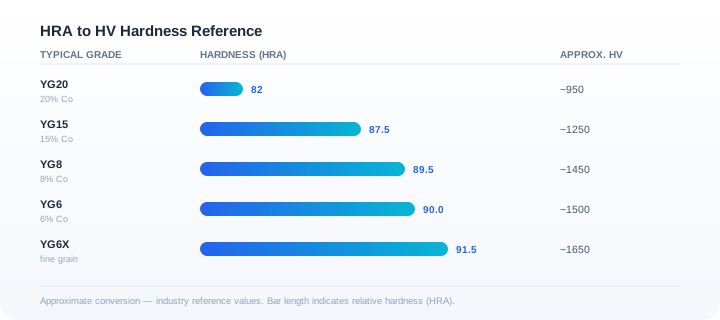
Hardness is quoted in different scales. This chart maps Rockwell (HRA) to Vickers (HV) for common cemented carbide grades.
Grade Selection & Metallurgy · Valves, Pumps & Fluid Seals · Severe Wear & Failure Mechanics · Custom Forming & Composite Assemblies
Microstructure integrity, binder formulations, hardness-toughness trade-offs, and corrosion / non-magnetic properties.
Start from observed failure modes rather than catalog numbers to balance abrasion and fracture toughness.
Master Grade Selection Strategy → →Interpreting micro-pores, coarse voids, and free graphite carbon under 200× metallographic inspection.
Examine ASTM B276 Porosity Limits → →Submicron tungsten carbide grains maximize hardness (HRA 91.5) for pure high-speed sliding abrasion.
Compare YG6 vs YG6X Abrasive Life → →Coarser grains and 15–20% cobalt binder absorb heavy mechanical impacts and suppress fracture propagation.
Select Impact-Resistant Shock Grades → →Fine-grain low-binder formulations maintain micro-hardness and suppress thermal plastic deformation above 400°C.
Evaluate Hot-Service Grade Limits → →Eliminating standard cobalt prevents catastrophic chemical binder leaching in acidic, brine, and sour media.
Prevent Acid & Sour Binder Leaching → →Specialized nickel alloys achieve low magnetic permeability (μ ≤ 1.05) for motor tooling and sensors.
Review Low-Permeability YN Specs → →Why cermet fracture toughness outperforms brittle ceramics under cyclic mechanical shock and dynamic loads.
Resolve Carbide vs Ceramic Dilemmas → →Comparing face distortion, dry-running survivability, and thermal shock resistance in mechanical seals.
Compare Mechanical Seal Face Materials → →When thin thermal-spray overlays wash out and solid sintered carbide provides true long-term wear protection.
Determine Hardfacing vs Solid Carbide → →Practical engineering guide to selecting grades, geometries, and manufacturing tolerances across industrial wear parts.
Browse Industrial Wear Parts Overview → →TRS numbers diverge from real part strength through surface notch sensitivity and EDM recast layers.
Read the ASTM B406 sourcing traps →Permeability limits, wire-EDM recast control and vacuum stress relief for magnet compaction tooling.
Review the non-magnetic carbide guide →Technical engineering guide on brazing tungsten carbide to steel: thermal expansion mismatch control, AWS BAg-24 and BAg-8 alloy selection, tri-foil shims, and quality standards.
Read the Can You Braze Tungsten guide →Seat and trim materials, plungers, mechanical seal faces, and the failure modes that decide them.
A 4-part specification covering pressure drop, sand velocity, binder metallurgy, and dimensional concentricity.
Draft Severe-Duty Choke Trim Specs → →Differentiating cavitation pitting, flashing wash-out, and high-velocity gas wire-drawing across seat faces.
Diagnose High-Pressure Valve Seat Failures → →Preventing brittle ceramic shattering during fast valve closure and cavitation pressure spikes.
Compare Valve Seat Impact Toughness → →Identifying abrasive scratching, hydrodynamic erosion, heat checking cracks, and corrosive matrix leaching.
Diagnose 4 Mechanical Seal Wear Modes → →Specifying optimal grades for rotating mechanical seal faces, abrasive slurry bushings, and letdown internals.
Locate Pump & Compressor Wear Points → →Holding tight sacrificial running clearances to prevent internal recirculation and pump volumetric efficiency collapse.
Maintain Slurry Pump Clearance Rings → →Directional flow scallops indicate kinetic erosion; random porous surface pitting indicates binder chemical leaching.
Identify Valve Surface Attack Mechanisms → →Surviving syngas ash erosion, high-temperature flashing, and aggressive chloride attack in coal gasification.
Engineer Coal Gasification Valve Trim → →Hydrodynamic mechanics: shallow-angle micro-cutting vs perpendicular impact fatigue in tungsten carbide flow passages.
Analyze Choke Slurry Erosion Dynamics → →70–300 MPa stroke cycles spall plungers unless grain size, pre-stress and surface finish match the load.
See how carbide plungers resist spalling →In metal-seated ball valves regulating 25 MPa slurry, tungsten carbide ball and seat pairs frequently develop leakage channels within 200 hours.
Read the Carbide Valve Balls and guide →Prevent decanter centrifuge tile throw-off and slurry erosion. Engineering guide on WC grades, BAg-24 sandwich brazing, and ISO 1940-1 G2.5 balance standards.
Read the Decanter Centrifuge Carbide Wear guide →Prevent homogenizer valve cracking and cavitation spalling. Engineering guide on WC-Ni grades, ISO H7/s6 pre-stress shrink fit, and Ra 0.02 mirror lapping.
Read the Carbide Homogenizer Valves: Cavitation guide →Prevent cracking and premature grooving in agitator bead mill carbide disperser discs. Engineering guide on WC grades, ISO 1940-1 G1.0, and ISO H7/h6 fits.
Read the Carbide Bead Mill Disperser guide →Combat grooving wear and spall fracture in hydrocyclone carbide apex nozzles. Technical guide on WC grades, ISO H8/f7 casing fits, and Sinter-HIP specs.
Read the Hydrocyclone Carbide Apex Nozzles: guide →Prevent heat checking and flatness distortion in tungsten carbide mechanical seal rings. Engineering guide on WC grades, ISO H7/h6 fits, and helium light bands.
Read the Carbide Mechanical Seal Rings: guide →Erosion, galling, chipping and thermal checking in extrusion, pelletizing, shearing and slitting.
Mitigating downhole wear: ESP pump bushings, flow choke beans, stabilizer inserts, and casing slips.
Review Downhole Tool Carbide Selection → →Non-magnetic mud pulser rotors, stators, and flow restrictors engineered for drillstring vibration and drilling mud scour.
Spec MWD/LWD Mud Pulser Components → →Protecting scroll flight edges, feed nozzles, and cake discharge ports against high-solids abrasive scour.
Extend Slurry Centrifuge Tile Life → →Precision diamond-honed carbide nozzle bores suppressing boundary layer turbulence and orifice expansion.
Configure Slurry & Blast Wear Nozzles → →Sub-micron grades hold a shearing apex and keep electrode burrs under 5 µm at line speed.
Control foil chipping with carbide slitter knives →1500–3600 rpm in a heated water bath: edge chipping and cavitation decide blade life.
Cut pelletizer edge chipping →Glass- and mineral-filled compounds drive three-body abrasion and galling on screw elements and liners.
Fight extruder abrasion and galling →Prevent mud pulser valve washout and binder leaching. WC-(Ni,Cr) grade selection, ISO H7/h6 fit tolerances, and EDM sourcing standards for MWD drilling tools.
Read the MWD Mud Pulser Rotors guide →Prevent egging and bore wear in abrasive waterjet carbide mixing tubes. Engineering guide on nano-WC grades, ISO H7/h6 fits, and φ0.005 mm concentricity.
Read the Abrasive Waterjet Carbide Mixing guide →Drawing and ironing dies, preforms and ground stock, steel-backed carbide assemblies, and near-net-shape sourcing.
Overcoming thermal expansion mismatch through tri-foil silver brazing, precision shrink-fitting, and wedge locking.
Master Carbide-to-Steel Brazing & Fitting → →Combining extreme carbide surface hardness with ductile steel backings to maximize structural impact resilience.
Design Composite Wear Components → →Preventing punch snap-through and fatigue spalling during high-speed stamping of advanced high-strength steel (AHSS).
Select Cold Heading Punch Microstructures → →Thermal crack resistance, roll pass geometry retention, and surface finish stability in hot and warm wire rod rolling.
Evaluate Metal Forming Carbide Rolls → →Maintaining circularity under 0.003 mm and sub-micron clearances on thin-wall carbide bearing sleeves.
Spec Precision Thin-Wall Bushing Tolerances → →Stripping brittle recast white layers and micro-cracks using optimized finish skim cuts and post-EDM polishing.
Eliminate Wire EDM Surface Recast Cracks → →Controlling camber, residual sintering stress, and diamond Blanchard grinding tolerances on precision flat plates.
Order Custom Ground Flat Stock → →Minimizing expensive diamond grinding by pressing and pre-forming custom blanks close to final component geometry.
Source Near-Net Shape Custom Preforms → →How internal corner radii, wall thickness, and GD&T callouts directly impact EDM hours, diamond tooling, and cost.
Optimize Custom Part Cost & Lead Times → →Comparing as-sintered (±0.15 mm), cylindrical ground (±0.005 mm), and optical lapped (±0.001 mm) limits.
Review Sintered vs Ground Tolerance Limits → →Economic trade-off analysis between stocking standard warehouse blanks versus customized near-net preforms.
Compare Standard Blanks vs Made-to-Print → →The 5-stage procurement pathway: print evaluation, metallurgical matching, pilot sintering, inspection, and delivery.
Follow the 5-Step Custom Ordering Process → →Essential print dimensions, duty conditions, and material requirements needed to receive a technical quote in 1–2 days.
Prepare Your Custom Sourcing Package → →Why small-batch custom wear parts benefit from dedicated metallurgy verification and consolidated manufacturing oversight.
Assess Sourcing Partner Advantages → →Body makers above 300 strokes per minute wear rings and gall unless grain size and finish are matched.
Stop ironing-die galling and wear →Entrance-ring wear, transverse thermal checking and core burst, answered by grain size and casing pre-stress.
Diagnose wire-drawing die failure →Prevent micro-chipping and WEDM recast cracking in motor lamination stamping punches. Sub-micron grades, H6/h5 tolerances, and lapping standards.
Read the Carbide Punches for Motor guide →Control 18-22% sintering shrinkage distortion and optimize WEDM machining allowances on tungsten carbide preforms. ISO H7/m6 fits and sourcing traps.
Read the Tungsten Carbide Preforms: Sintering guide →Send the drawing and the operating conditions — we'll recommend the grade and quote it.
Deep dives written for a specific industrial cluster — same grades and tolerance data as our technical guides, mapped onto the parts that cluster actually wears out.
Gulf Coast frac manifolds and high-pressure-drop choke service: erosion-first grade selection, H2S / sour-service binder choice, and the lapped-seat tolerances that actually hold up.
Great Lakes automotive and electrical stamping corridor: high-toughness punch grades resisting AHSS snap-through, wire EDM micro-crack elimination, and precision ground tooling inserts holding ±0.002–0.005 mm.
Read the Midwest tooling guide →
Athabasca oil sands tailings, bitumous slurries, and severe mining service: coarse quartz erosion defense, corrosion-resistant nickel binders against leaching, and throatbush wear ring tolerances.